Lambourn / Lambourne / Chipping Lamborne
The name of the West Berkshire village of Lambourn has attracted etymological interest for centuries. Two principal theories have been proposed, one rooted in Old English and the other in Brythonic.
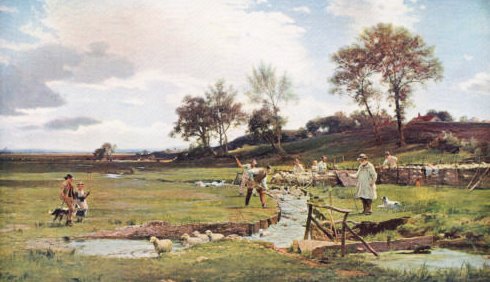
The Old English explanation, which remains the prevailing interpretation, derives Lambourn from the elements lamb and burna, meaning “stream” or “spring.” The composite therefore denotes “lamb-stream.” Such a derivation is supported by the earliest recorded forms of the name, notably Lamburna in the Domesday Book of 1086 (Williams and Martin, 2002). Further attestations include Lamborne (c. 1180) and Lamburn (13th century), each preserving the fundamental elements of the Old English root (Mills, 2011). This interpretation is also consistent with the pastoral economy of the Lambourn Valley, where sheep farming was long established, and with the River Lambourn itself, which flows through the village and has traditionally been associated with the washing or dipping of lambs.
The alternative hypothesis proposes a Brythonic origin, suggesting that Lambourn derives from llan (“enclosure”) and bryn (“hill”). This would yield the meaning “enclosure on a hill” and would not be out of place in the landscape, given the proximity of ancient earthworks such as Uffington Castle. However, it lacks direct documentary evidence in medieval charters and does not correspond with the recorded Old English spellings of the settlement’s name. Place-name scholars generally regard the Brythonic suggestion as somewhat speculative (Gelling and Cole, 2000).
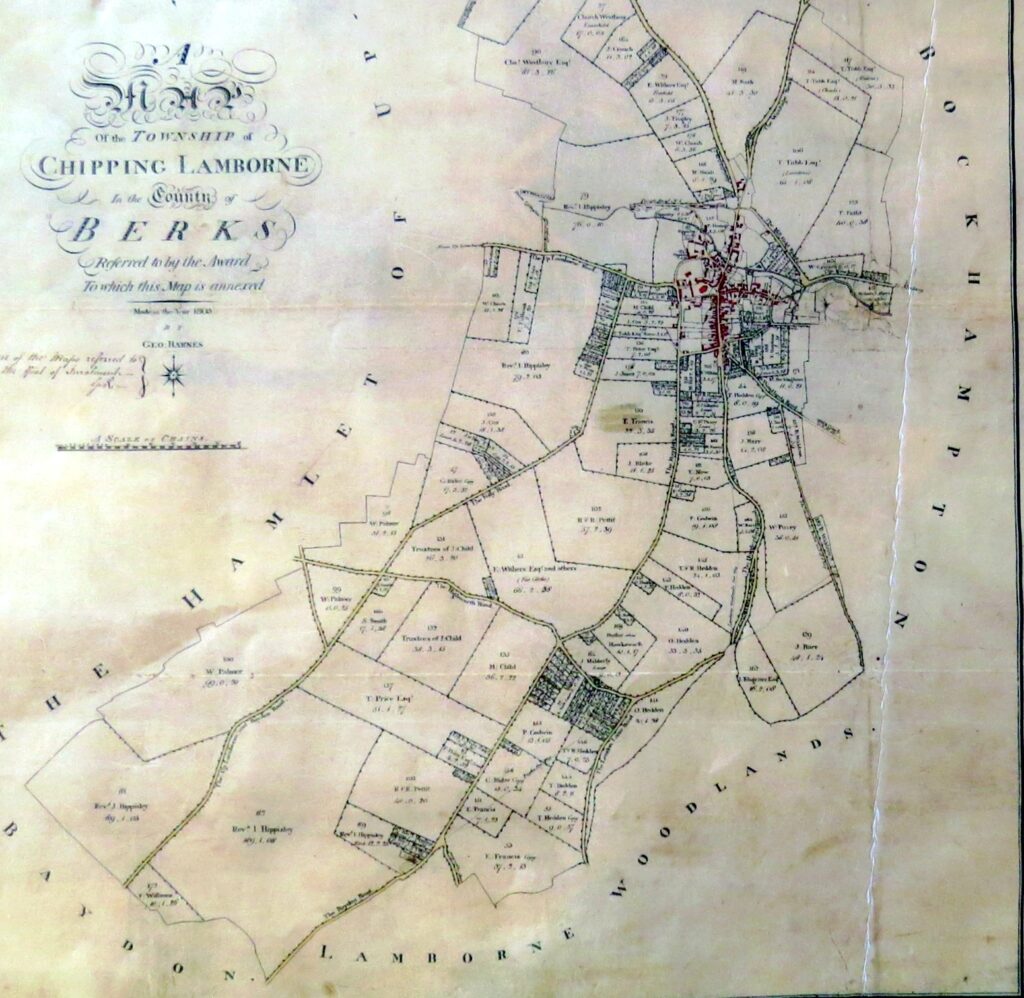
In addition to these etymological discussions, the village was historically styled Chipping Lambourn, with “Chipping” derived from the Middle English chepying, meaning “market” (Reaney, 1991). Documentary evidence shows that Lambourn was granted a market in the early 13th century, emphasising its role as a local trading centre and distinguishing it from neighbouring settlements. You can read more about Chipping Lamborne in this article by Mick Dowdeswell
Taken together, the evidence strongly supports the Old English derivation. The consistency of medieval spellings, the linguistic plausibility of lamb + burna, and the agricultural context of the Lambourn Valley all favour the interpretation of Lambourn as “the lamb-stream.”
Shefford
The name Shefford, as preserved in Great Shefford and its surrounding hamlets in West Berkshire, derives from the Old English scēap ford, meaning “sheep ford.” It referred to a shallow crossing of a river used for driving sheep across the water (Mills, 2011).
The Domesday Book of 1086 records the settlement as Siford, while later medieval variants include Shipford (1229), Shepford (1247), Sefford (mid-13th century), Schefford (1262–71), and Sheford (1276–97) (Ekwall, 1960). These forms clearly illustrate the phonological development of the place-name across the centuries.
The meaning is topographical rather than personal, emphasising the practical significance of the ford for livestock husbandry in a sheep-rearing district. The River Lambourn, which runs through the village, is the most likely site of this original crossing (Gelling & Cole, 2000).
Downs
The rolling chalk hills of South Oxfordshire and Berkshire, known collectively as the Downs, take their name from the Old English dūn, meaning “hill” or “upland.” This should not be confused with the modern verb “to go down.” Early spellings appear in Anglo-Saxon charters and are preserved in place-names such as Dunstable and Downton (Ekwall, 1960).
The word itself is older still, ultimately deriving from Celtic roots cognate with Welsh dîn and Gaelic dùn, both signifying a fort or hill-fort (Jackson, 1953). This reflects the prominence of defended uplands in prehistoric Britain, many of which remain visible across the Berkshire Downs.
By the Middle English period dūn had come to denote open chalk pasture, especially land suited to sheep grazing, and the plural “Downs” was used for ranges of such hills. The Berkshire and Oxfordshire Downs, with their long pastoral history, exemplify this evolution.
Thus the name “Downs” encapsulates both the physical form of the chalk uplands and a linguistic inheritance stretching back to Britain’s earliest inhabitants.
East Garston
The name East Garston originates in the Old English personal name Asgar, combined with tūn, meaning an enclosed farmstead or settlement. The sense is therefore “Asgar’s tūn,” denoting a village or manor held by a Saxon landholder.
Historical records note that the form Argeston remained in popular use until the early twentieth century, while the form East Garston is documented on a map of 1607. This reflects the natural phonological evolution of the name from Old English to its present form.
Following the Norman Conquest, Asgar’s lands were transferred to Geoffrey de Mandeville. The Domesday Book of 1086 duly records the settlement under his tenure, demonstrating both continuity of habitation and the enduring significance of the estate in the Lambourn Valley.
Ashdown
The toponym Ashdown, as preserved in the name of Ashdown House in Berkshire, derives from Old English elements that reflect both flora and topography. The first element, æsc, denotes the ash tree, a species widely distributed in early medieval England and closely associated with the light, chalky soils of the Berkshire Downs [Gelling, Signposts to the Past, 1988]. The second element, dūn, originally meaning “hill” or “upland,” came in southern England to denote the characteristic chalk downs that stretch across Berkshire, Wiltshire and Oxfordshire [Ekwall, Concise Oxford Dictionary of English Place-Names, 1960].
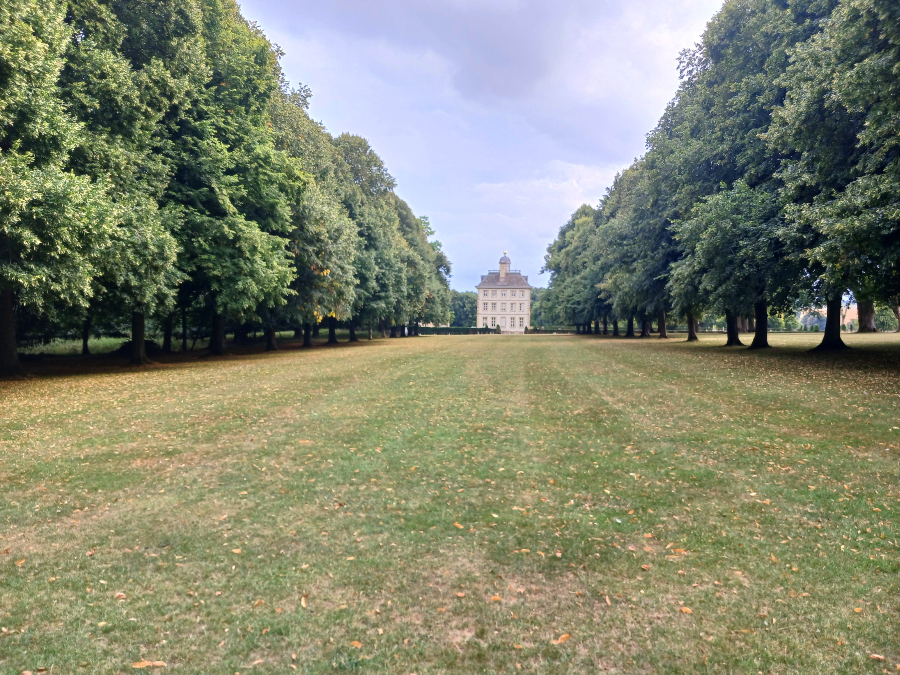
Taken together, æsc-dūn signifies “ash-covered hill” or “hill where ash trees grow” [Mills, A Dictionary of British Place Names, 2011]. The name is thus a direct linguistic reflection of the wooded upland landscape in which the site is situated. Ashdown House itself, a 17th-century mansion built for William Craven, Earl of Craven, in honour of Elizabeth of Bohemia, occupies a prominent position on the Downs, its name evoking both the natural environment of ash woodland and the chalk hills on which it stands [Pevsner, The Buildings of England: Berkshire, 1966].
The etymology of Ashdown accords with a broader pattern in English place-names, where dūn frequently combines with tree-names or other natural features to describe the upland environment [Watts, The Cambridge Dictionary of English Place-Names, 2004].



I understand that people of the hamlet love their sheep, but the name Lambourn does not come from washing lambs in the river. If that were the case, why would everything in the area be named for washing sheep, like Lambourn Woodlands, Lambourn Downs, Lambourne Barrows (burial places). The word lamb is Saxon and the word Bourn is Brythonic. Doesn’t it make more sense that both word origins would be Brythonic? Llan Byrn means enclosed hill which is the dominant Neolithic structure in the area now known as Uffington Castle, but that was historically called Llyn Byrn (anglicized to Lambourn), the enclosed hill, and it was obviously the center of power in the area with the Kings Way passing beneath and between it and Dragon Hill with the Great White Horse carved into the escarpment. That is a feature that predates all the peoples of the area and the language was proto-Celtic. Lan Byrn was the area and the name given to all the area from ancient times and today called Lambourn. It is not about washing sheep.