This is ‘Diolite’ the 1930 English Derby ‘favourite’, trained by Fred Templeman at Elmfield, Lambourn, being led down Newbury Street, Lambourn, in 1930.
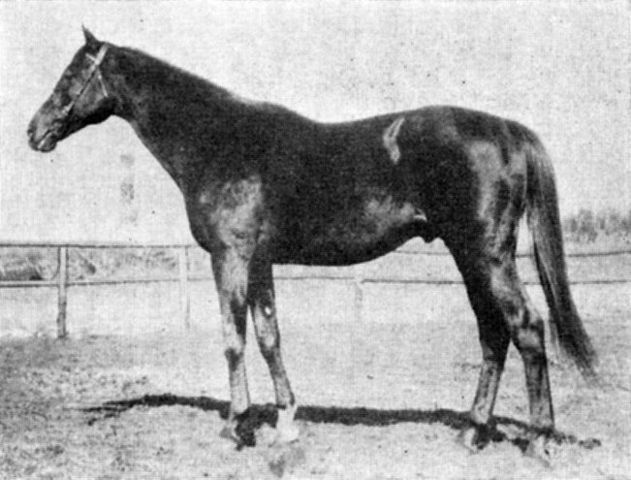
Diolite was a “well made” bay horse “of medium size, with a good action” bred by C W Birkin. As a yearling in October 1928 he was offered for sale at Doncaster and bought for 480 guineas by Hugo Hirst. The colt was sent into training with Fred Templeman at Lambourn in Berkshire.
Diolite was probably the best horse sired by Diophon, who won the 2000 Guineas in 1924. Diolite’s dam Needle Rock also produced Lady Kroon, the female-line ancestor of Lavandin.
1929: two-year-old season
Until 1946 two-year-old racehorses in Britain did not have to be officially named and the colt who was to become Diolite was unnamed on his racecourse debut in April 1929 when he finished third to the Aga Khan’s Blenheim in the Manton Plate at Newmarket Racecourse. After then finishing second at Goodwood Racecourse he recorded his first success in the Spring Stakes at Newmarket in May. At Royal Ascot in June he started at odds of 7/1 in the Coventry Stakes and won from Lovat Scout. In the following month at Goodwood Racecourse he took the Molecomb Stakes, beating the fillies Qurrat-Al Ain and Grace Dalrymple at odds of 3/1.
In the Free Handicap, a ranking of the season’s best juveniles Diolite received a weight of 129 pounds making him the best British two-year-old of 1929 ahead of Press Gang (128), Challenger (127) and Blenheim (126).
1930: three-year-old season
On 7 May 1930, Diolite, ridden by Freddie Fox, started at odds of 10/1 in a 28-runner field for the 122nd running of the 2000 Guineas over the Rowley Mile at Newmarket. The race was attended by the King and attracted enormous betting interest, with a record £9,308 being wagered on The Tote. Fox restrained the colt just behind the leaders before allowing Diolite to sprint clear inside the final furlong and win “easily” by two lengths from Paradine, with Silver Flare a length away in third place. After the race Hugo Hirst commented “I always fancied the chance Diolite and I was justified. I think he will win the Derby”.
In the Derby over one and a half miles at Epsom Racecourse on 4 June Diolite started 11/4 favourite against sixteen opponents, despite doubts about his ability to stay the distance. He was among the leaders for most of the way and took the lead early in the straight but was overtaken in the closing stages and finished third behind Blenheim and Illiad, beaten three lengths by the winner. There were some suggestions that Diolite’s jockey C. Day was at fault for going too quickly in the early stages instead of holding the colt up for a late run. At Royal Ascot later in June, Diolite was dropped back to sprint distances for the five furlong Fern Hill Stakes and finished third behind Stingo.
Diolite returned for the St. Leger over fourteen and a half furlongs at Doncaster Racecourse but appeared to run short of stamina as he came home seventh behind Singapore. A month later the colt finished unplaced behind Rutom Pasha in the Champion Stakes. In November Hirst declined a challenge to send Diolite to Australia for a match race against Phar Lap, suggesting instead that the Australian champion should be sent to England.
Later career
Diolite remained in training as a four-year-old but failed to recover his best form and recorded his only victory in a handicap race at Liverpool.[5] In April 1931 he finished unplaced in the Great Jubilee Handicap at Kempton Park Racecourse.[20] In October he finished second to the three-year-old Portlaw in the Challenge Stakes at Newmarket, beaten by three quarters of a length in a two-runner race.[21] In April 1932 he was strongly fancied for the Lincoln Handicap but finished unplaced behind Jerome Fandor.
Mick Dowdeswell / Wikipedia